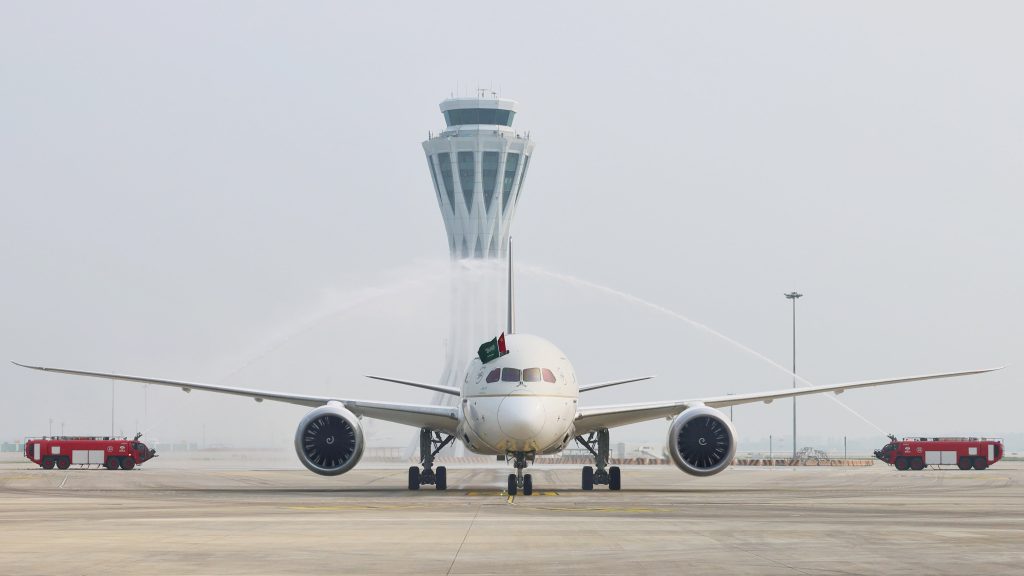
[Industry insight] After nearly a decade, Boeing may finally have an opportunity to secure a major aircraft order from China. According to reports, China is considering the purchase of 500 Boeing 737 MAX aircraft, with the order expected to be announced during the visit of Donald Trump to China.
Trump’s visit is scheduled for March 31–April 2, marking his first state visit to China since 2017. Aircraft procurement has become one of the key issues in bilateral negotiations. Boosted by the news, Boeing’s share price has already risen by 3.7%.
At the same time, Boeing is also in talks with Chinese counterparts regarding a potential order for around 100 widebody aircraft, including the Boeing 787 Dreamliner and the Boeing 777X, though those deals may be announced at a later stage. Notably, while negotiating with Boeing, China has also been discussing another potential order for 500 aircraft with Airbus. That deal has been under intermittent negotiation for years and has yet to be finalized.
Historically, China has been one of Boeing’s core markets, with Chinese orders once accounting for 25% of the manufacturer’s total order book. In recent years, however, that share has declined sharply. Chinese airlines currently have 133 aircraft on order from Boeing, representing roughly 2% of its total orders.
The potential order could be a key opportunity for Boeing to reverse its declining market position in China. Since taking office, Trump has repeatedly encouraged foreign airlines to place orders with Boeing. Previously, airlines in Japan and South Korea placed orders for more than 100 Boeing aircraft under similar pressure, while related trade agreements also resulted in favorable tariff adjustments for the two countries.
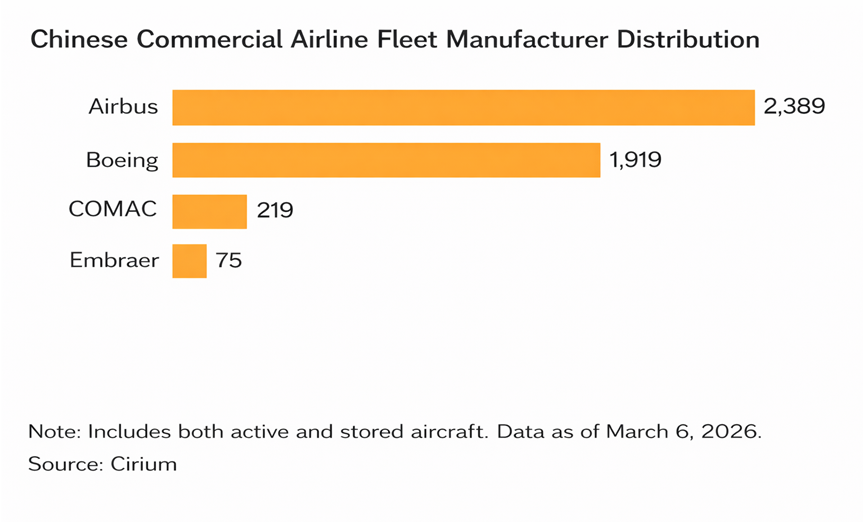
For many countries, aircraft procurement serves as a visible symbol of bilateral trade cooperation while having minimal impact on domestic commodity markets, resulting in relatively limited political resistance. At the same time, China’s aviation market continues to show strong demand for new aircraft. China currently has 41 passenger airlines and 11 cargo airlines. As of March 6, 2026, the combined fleet of these 52 airlines totals 4,573 aircraft, including both active and parked aircraft.
Of these, 2,389 aircraft are produced by Airbus, accounting for about 52% of the fleet; 1,919 aircraft are from Boeing, representing about 42%; 219 aircraft are produced by Commercial Aircraft Corporation of China; and 75 aircraft are from Embraer.
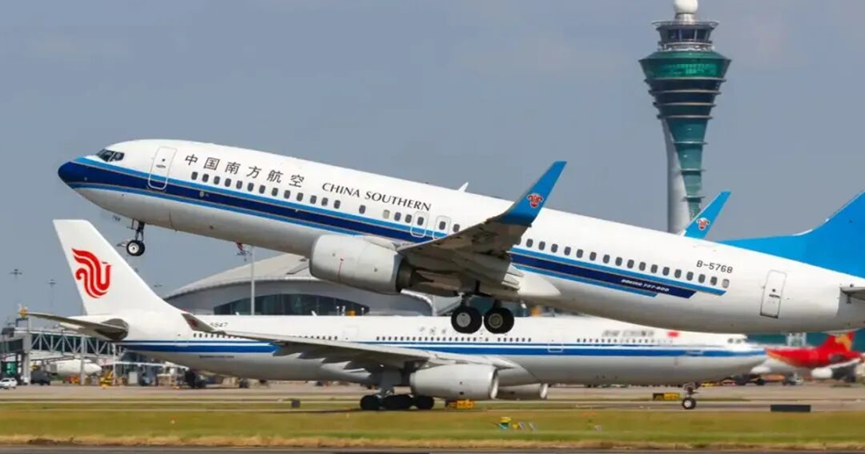
From a fleet structure perspective, passenger and cargo airlines show notable differences in aircraft preferences. Among the 41 passenger airlines, 19 primarily operate Boeing aircraft, while 22 focus mainly on Airbus models, including China’s three major state-owned carriers.
Among the 11 cargo airlines, Boeing aircraft dominate the fleets of all except one carrier, with nine cargo airlines operating all-Boeing fleets.
China’s airline fleets are currently entering a concentrated replacement cycle. Many of the main aircraft types are 6–10 years old, while large batches of 737 and A320 family aircraft introduced between 2011 and 2016 are gradually approaching a 10–15 year retirement window.
Older aircraft not only incur higher maintenance and fuel costs, but increased ground time can also reduce operational flexibility and significantly raise airline operating expenses. For airlines, replacing older aircraft with new-generation models is often a more economical option. Delivery timelines, fuel efficiency, and maintenance convenience have therefore become key considerations in procurement decisions.
According to forecasts by the International Air Transport Association, China is expected to surpass the United States around 2030 to become the world’s largest aviation market. This vast growth potential has made China a core strategic market for both Airbus and Boeing.
At present, China and Boeing are still negotiating the specific details of the potential order, and no final agreement has yet been reached. Boeing still has 134 aircraft orders from Chinese airlines pending delivery.
Globally, Boeing’s commercial aircraft backlog has exceeded 6,100 aircraft, including approximately 4,600 Boeing 737 MAX aircraft, with a total backlog value of about US$682 billion, the highest on record.
Even if the deal is concluded, the delivery of these 737 MAX aircraft is unlikely to occur in the short term, as the production backlog is already scheduled through 2029. Nevertheless, the potential order reflects a warming trend in China–U.S. trade relations and aligns with the development of China’s civil aviation market and the practical needs of fleet renewal.
#Trump visit China #aircraft purchase, aviation PR #aviation marketing agency China #Boeing aircraft #China aviation market growth #US-China trade relations